Lake Charles sits in one of the most flood-prone regions in the United States. With Calcasieu Lake to the south, Contraband Bayou running through the city, and a Gulf Coast climate that brings hurricanes, tropical storms, and heavy seasonal rains, flooding is not a matter of if it’s a matter of when. When floodwaters invade your home or business, fast and informed action is the difference between a manageable recovery and a devastating, costly rebuild.
This comprehensive guide walks you through everything Lake Charles homeowners and property managers need to know about flood restoration from the moment water enters your property to the final step of getting your home declared safe and fully restored.
What Is Flood Restoration?
Flood restoration is the complete process of removing water, drying out affected structures, preventing mold growth, and repairing all damage caused by flooding. It goes far beyond simply mopping up water. A true professional restoration includes:
- Emergency water extraction to remove standing water within hours
- Structural drying using industrial dehumidifiers and air movers
- Mold prevention and remediation to eliminate health hazards
- Damage assessment and documentation for insurance claims
- Reconstruction and repair of flooring, drywall, ceilings, and more
In Lake Charles, flood restoration carries unique challenges due to the region’s high humidity, clay-heavy soils, and the recurring threat of severe storms. Working with a locally knowledgeable team is critical.
Why Lake Charles Is Especially Vulnerable to Flooding
Understanding your local flood risk helps you prepare smarter and respond faster. Lake Charles and the surrounding Calcasieu Parish communities face multiple flood triggers:
Hurricane and Tropical Storm Flooding: Lake Charles was devastated by back-to-back Hurricanes Laura and Delta in 2020, two of the most damaging storms in Louisiana history. Storm surge, inland flooding, and extreme wind damage combined to create a multi-layered restoration challenge for thousands of residents.
Heavy Rain Events: Southwest Louisiana averages over 55 inches of rain annually. Even without a named storm, intense rainfall can overwhelm drainage systems in neighborhoods from Prien Lake and Moss Bluff to Westlake and Sulphur.
Bayou and Lake Overflow: Areas near Contraband Bayou, Lake Charles, and Calcasieu Lake are especially susceptible to water rising from natural water bodies during prolonged rain events.
Aging Infrastructure: Older neighborhoods like Broadmoor, Charpentier District, and downtown Lake Charles may have infrastructure that struggles to handle modern storm volumes.
If your property is in any of these areas, having a flood response plan and knowing a trusted water damage restoration company in Lake Charles on speed dial is essential.
The 7 Critical Steps of Flood Restoration
Step 1: Ensure Safety Before You Enter
Before setting foot in a flooded property, confirm that:
- The electrical power to the affected area has been shut off at the breaker
- There are no visible structural dangers (collapsed ceilings, buckled floors)
- The floodwater has fully receded or been confirmed non-toxic
- You have proper protective gear (rubber boots, gloves, N95 mask)
Floodwater in Lake Charles can carry sewage, chemicals from industrial runoff, and dangerous bacteria. Category 3 “black water” the most contaminated type is common after major flooding events and requires professional handling.
Step 2: Call a Professional Flood Restoration Team Immediately
Time is your biggest enemy after a flood. Within 24–48 hours, mold colonies can begin forming in wet drywall, insulation, and under flooring. Structural components absorb moisture rapidly, and the longer they stay wet, the more expensive the repair becomes.
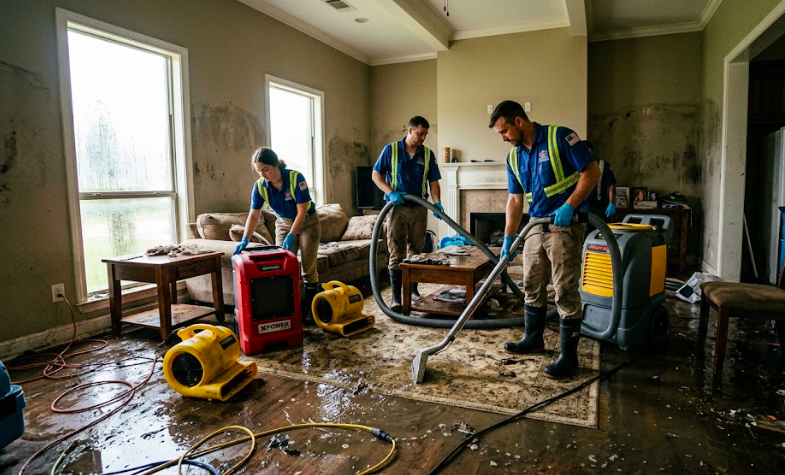
Our flood damage cleanup team in Lake Charles is available 24 hours a day, 7 days a week for emergency response. We arrive with truck-mounted extractors and industrial-grade drying equipment to begin stopping damage from the moment we walk in the door.
Call (337) 454-5084 anytime for an immediate dispatch.
Step 3: Emergency Water Extraction
The first physical step in every restoration is removing all standing water as quickly as possible. Our team uses:
- Truck-mounted water extractors capable of removing thousands of gallons per hour
- Submersible pumps for flooded basements and crawlspaces
- Wet/dry vacuums for residual moisture in tight spaces
This step is not something a home dehumidifier or shop vac can adequately handle after a significant flood event. Powerful commercial-grade extraction equipment is required to pull water out of carpet padding, subfloor layers, and wall cavities places moisture hides that lead to mold weeks later.
Step 4: Structural Drying and Dehumidification
Once standing water is removed, the real drying process begins. This phase typically takes 3–5 days but can extend longer in high-humidity environments like Lake Charles. Our structural drying and dehumidification services use:
- Commercial LGR dehumidifiers that can remove hundreds of pints of moisture per day
- High-velocity air movers positioned to maximize airflow through walls and under flooring
- Desiccant systems for especially persistent moisture in concrete, masonry, and thick structural components
- Moisture meters and thermal imaging cameras to verify dryness behind walls without unnecessary demolition
We monitor your property daily throughout the drying process and keep a log of moisture readings documentation that is also invaluable for your insurance claim.
Step 5: Mold Inspection and Remediation
Even with rapid response, Lake Charles’s subtropical climate means mold risk is ever-present after a flood. Mold can begin growing within 24–48 hours in warm, wet conditions and it often hides inside walls, under floors, and in attic spaces before it’s visible to the naked eye.
Our mold removal and remediation services include:
- Professional mold testing and inspection to identify all affected areas
- Containment setup to prevent mold spores from spreading to unaffected rooms
- HEPA vacuuming and antimicrobial treatment of all affected surfaces
- Safe disposal of materials that cannot be restored (heavily contaminated drywall, insulation, carpet)
- Post-remediation clearance testing to confirm your home is safe before rebuilding
Do not attempt to clean visible mold with bleach and call it done. Bleach does not penetrate porous materials, and the underlying root structure of the mold colony will regrow. Professional remediation is the only reliable solution.
Step 6: Damage Documentation for Insurance
A thorough, well-documented insurance claim is critical to getting fair compensation after a flood. Our restoration team helps Lake Charles homeowners by:
- Photographing and cataloging all damage before any removal
- Providing detailed moisture logs and drying reports
- Writing itemized damage assessments
- Communicating directly with your insurance adjuster when needed
Louisiana’s insurance landscape after the 2020 hurricanes changed significantly, with many carriers adding flood exclusions. Whether you carry NFIP (National Flood Insurance Program) coverage or a private flood policy, having professional documentation on your side is invaluable.
Step 7: Restoration and Reconstruction
Once the property is dry and mold-free, rebuilding begins. Depending on the severity of the flood, this may include:
- Drywall water damage repair-removing and replacing saturated drywall and insulation
- Flooring restoration or replacement-hardwood, tile, carpet, and subfloor work
- Ceiling water damage restoration-addressing water stains, sagging, and structural ceiling damage
- Sewage backup cleanup-full sanitation and decontamination for sewage-affected areas
- Painting and finishing-to return the property to its pre-loss condition
Our goal is to hand you back a home that is not just dry, but fully restored structurally sound, mold-free, and safe for your family.
Flood Damage vs. Water Damage: What’s the Difference for Lake Charles Homeowners?
Many homeowners confuse “flood damage” with “water damage,” but the distinction matters enormously for insurance purposes.
Water damage typically refers to damage caused by water from within the structure a burst pipe, overflowing appliance, roof leak, or HVAC failure. Standard homeowners insurance usually covers this.
Flood damage refers to water entering from outside the structure due to rising surface water, storm surge, or overflow from bodies of water. This is not covered by standard homeowners insurance and requires a separate flood insurance policy through NFIP or a private carrier.
If you’re unsure which type of event caused your damage, our technicians can help document the source a critical distinction for your claim.
Common Flood Damage Scenarios in Lake Charles
Flooded Basement or Crawlspace
Lake Charles homes with crawlspaces (common throughout Calcasieu Parish) are highly vulnerable to standing water accumulation after heavy rains. Water sitting in a crawlspace creates perfect mold conditions and can rot structural floor joists within weeks. Our flooded basement cleanup and crawlspace water extraction teams handle complete extraction, drying, and mold prevention for below-grade spaces.
Hurricane Storm Surge Damage
Storm surge flooding as experienced across Lake Charles neighborhoods during Hurricane Laura combines extreme water intrusion with windborne debris and potential sewage contamination. Our hurricane response services are calibrated specifically for the multi-layered restoration challenges that major Gulf Coast storms create.
Sewage Backup During Flooding
When the municipal sewer system becomes overwhelmed during major rain events, sewage can back up through floor drains, toilets, and sinks. This is a biohazard situation requiring specialized protective equipment, EPA-approved disinfectants, and professional disposal of contaminated materials. Do not attempt cleanup yourself.
Appliance and Plumbing Failures Triggered by Storm Damage
High winds and structural movement during storms can rupture water lines, damage water heaters, and cause appliance failures that compound flood damage. Our burst pipe damage cleanup team addresses these secondary water damage sources as part of a comprehensive restoration.
Flood Restoration Timeline: What to Expect
| Phase | Timeframe | What Happens |
|---|---|---|
| Emergency Response | 0–2 hours | Dispatch, safety assessment, water extraction begins |
| Water Removal | 2–8 hours | Complete standing water extraction |
| Structural Drying | 3–7 days | Continuous drying with monitoring |
| Mold Assessment | Day 3–5 | Moisture testing, mold inspection |
| Demo & Removal | Day 5–10 | Damaged materials removed and disposed of |
| Reconstruction | 1–4 weeks | Rebuilding drywall, floors, ceilings, finishes |
| Final Clearance | Post-reconstruction | Inspection and documentation |
Timelines vary based on flood severity, square footage affected, and the extent of structural damage. We provide realistic timelines and keep you updated every step of the way.
How to Prepare Your Lake Charles Home for Future Flooding
Prevention and preparation reduce both damage severity and restoration costs. Here are steps every Lake Charles homeowner should take:
Elevate critical systems. HVAC units, water heaters, and electrical panels should be elevated above the base flood elevation for your specific area. FEMA’s flood maps for Calcasieu Parish provide the base flood elevation data for your address.
Install a sump pump with battery backup. For homes with crawlspaces or lower-level spaces, a quality sump pump can remove groundwater intrusion before it reaches damaging levels. A battery backup ensures it continues operating during power outages which are common during the storms that also bring flooding.
Apply mold-resistant coatings. Our mold prevention coatings service can treat crawlspaces, basement walls, and other high-risk surfaces to reduce mold vulnerability after moisture exposure.
Seal crawlspace vents. In Lake Charles’s humid climate, open crawlspace vents actually allow humid outdoor air in, which condenses on cooler surfaces and feeds mold. Sealed and conditioned crawlspaces significantly reduce this risk. Learn more about our crawlspace vent sealing and conditioning service.
Document your belongings. Maintain a home inventory with photos or video of your possessions. Store it in a cloud-based service so it survives even if your devices are destroyed in a flood.
Know your evacuation route. Calcasieu Parish has established evacuation zones know which zone your home is in and have a plan ready before storm season begins.
Areas We Serve Across Greater Lake Charles
Lake Charles Rapid Restore provides 24/7 flood restoration services throughout Calcasieu Parish, including:
- Central and Downtown Lake Charles (70601) — including Broadmoor, Charpentier District, and Riverside neighborhoods
- South Lake Charles and Prien (70605) — including Prien Lake area, Cypress Lake, and surrounding subdivisions
- Moss Bluff (70611) — including Nelson Road Park, The Bluff, and The Colony neighborhoods
- Westlake (70669) — across the Calcasieu River from Lake Charles
- Sulphur, Carlyss, and Iowa — serving all communities west and south of Lake Charles
No matter where in the greater Lake Charles area you are, we can be on-site quickly. Call (337) 454-5084 and our team will confirm a dispatch time immediately.
Why Choose Lake Charles Rapid Restore?
IICRC-Certified Technicians. Our team holds certifications from the Institute of Inspection, Cleaning and Restoration Certification the gold standard for restoration professionals. This means your project is handled using proven, industry-accepted standards and techniques.
Local Knowledge That Matters. We’re not a national franchise dispatching technicians unfamiliar with Southwest Louisiana. We live and work here. We understand Calcasieu Parish’s unique flood patterns, local building codes, and insurance landscape in ways that out-of-area contractors simply don’t.
Fully Licensed and Insured. Every project is covered by comprehensive liability insurance, protecting you from additional risk during the restoration process.
Direct Insurance Coordination. We work directly with insurance adjusters on your behalf, ensuring damage is properly documented and your claim is supported by professional records.
No Hidden Costs. We provide transparent, itemized estimates before work begins. You’ll never be surprised by our invoice.
24/7 Emergency Availability. Flooding doesn’t follow business hours. Neither do we. Day or night, weekends or holidays call us and we respond.
Frequently Asked Questions About Flood Restoration in Lake Charles
How quickly can your team arrive after a flood?
For emergency calls in Lake Charles and surrounding Calcasieu Parish, our typical response time is 1–2 hours. Call (337) 454-5084 for an immediate dispatch.
Can I stay in my home during the restoration?
It depends on the extent of damage. For smaller-scale water intrusion affecting one room or area, many homeowners remain in their home. For extensive flooding affecting multiple rooms, or any flooding involving sewage contamination, temporary relocation is strongly recommended for health and safety.
Will my homeowner’s insurance cover flood restoration?
Standard homeowners insurance does not cover flooding from outside sources (rising water, storm surge). You need a separate flood insurance policy for that coverage. However, water damage from internal sources (burst pipes, appliance leaks) is typically covered. We can help you document damage and work with your insurer regardless of coverage type.
How long does the drying process take?
Most residential projects require 3–5 days of continuous drying. Factors that extend drying time include concrete slab construction, thick insulation, high ambient humidity, and large affected areas. We monitor moisture levels daily and only cease drying when readings confirm structural dryness.
What if I find mold weeks after a flood?
Call us immediately. Delayed mold growth is common and addressable. The sooner remediation begins, the less the mold spreads. Our mold inspection and testing service will identify the full extent of growth and we’ll provide a complete remediation plan.
Do you help with contents restoration?
Yes. In addition to structural restoration, we can assist with salvaging and restoring personal contents where possible, and provide documentation of non-salvageable items for insurance purposes.
Don’t Wait Every Hour Counts After a Flood
In Lake Charles’s warm, humid climate, water damage escalates faster than almost anywhere else in the country. Within the first 24 hours, mold begins forming, wood starts warping, drywall begins crumbling, and the costs of restoration climb rapidly.
If your home or business has been flooded whether by hurricane storm surge, heavy rain, a burst pipe, or a sewage backup the most important thing you can do right now is call a professional restoration team.
Lake Charles Rapid Restore is available 24 hours a day, 7 days a week.
Call (337) 454-5084 for immediate emergency response.
Or visit our home page to request a free quote and learn more about our complete restoration services.
Leave a Reply