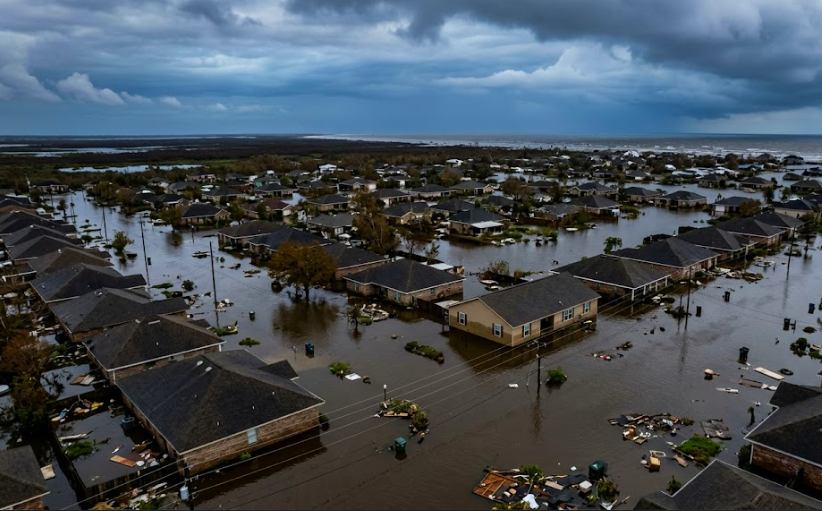
Lake Charles has faced more than its share of major weather events. Residents here don’t need to be told that water damage is serious — they’ve lived it. What many homeowners still don’t fully understand, however, is why Gulf Coast storm damage requires a fundamentally different restoration approach than most other types of water intrusion, and why choosing the wrong company can leave you with hidden moisture problems that surface months later.
Storm Surge Is Not the Same as Flooding
There’s an important distinction that affects your entire restoration process: storm surge and inland flooding are categorized differently, and they require different responses.
Inland flash flooding the kind that follows heavy rainfall often involves Category 2 water (gray water with some contamination). Storm surge from the Gulf, however, is almost always Category 3 black water from the moment it enters your home. It carries saltwater intrusion, petrochemical runoff from Louisiana’s industrial corridor, sewage backflow, and biological material. According to FEMA’s flood damage guidelines, structures affected by storm surge require full decontamination protocols not just drying.
This distinction matters enormously for your insurance claim as well. Storm surge damage is typically covered under the National Flood Insurance Program (NFIP), not your standard homeowner’s policy. Confusing the two is one of the most expensive mistakes Lake Charles homeowners make in the aftermath of a major storm.
Louisiana’s Hidden Restoration Challenge: The Water Table
Even after floodwater recedes, Lake Charles homes face a problem that out-of-state contractors consistently underestimate: our region’s water table sits extremely close to the surface. In many neighborhoods across Calcasieu Parish, the natural groundwater level is just 2–4 feet below grade. This means:
- Crawlspace foundations remain perpetually damp even without a flood event
- Slab foundations can wick moisture upward for weeks after surface water clears
- Exterior humidity averaging 80–90% means materials air-dry far more slowly than in other regions
Standard drying timelines used in drier climates are simply wrong for Southwest Louisiana. Our moisture readings and drying logs have to account for ambient conditions that are unlike almost anywhere else in the country.
A Useful Contrast: How Other Regions Handle Water Damage
Understanding what makes Lake Charles unique becomes clearer when you look at how different our challenges are from other markets. Take South Texas, for example the restoration professionals at McAllen TX Water Damage operate in a high-heat, low-water-table environment where their primary enemy after a flood event is mold acceleration driven by extreme temperatures. Their protocols are built around rapid dehumidification and mold prevention in 100°F+ conditions – challenges we share in summer, but compounded here by our persistently high outdoor humidity that never lets up the way desert heat does overnight.
The underlying point is the same: regional expertise is not optional in water damage restoration. The physics of drying buildings change based on local temperature, humidity, soil conditions, and building construction norms. A company doing its first job in Calcasieu Parish will not produce the same results as one that has spent years learning this specific environment.
What to Do After Storm Damage in Lake Charles
- Do not re-enter until the structure is declared safe – storm surge events can compromise foundations and introduce electrical hazards
- Photograph and video everything – before any cleanup, for both insurance and contractor documentation
- Verify NFIP coverage – contact your flood insurance carrier before signing any restoration contracts
- Demand a full moisture map – any reputable restoration company should provide moisture readings at multiple points before and after drying
Lake Charles has rebuilt before, and the community knows how to recover. Our job is to make sure your home is truly dry not just dry on the surface so you’re not dealing with mold or structural issues six months down the road.
Serving Lake Charles, Sulphur, Westlake, DeQuincy, and all of Calcasieu Parish. 24/7 emergency response – call us the moment water enters your home.
Leave a Reply